


On September 28, the 3rd Marine Spatial Planning Cooperation Workshop of Maritime Silk Road Partner Countries & the Conference of Marine Spatial Planning Partnership was grandly opened in Beijing, bringing together more than 120 representatives from over 60 countries and international organizations, as well as over 200 representatives from domestic institutions. The conference not only deepened marine cooperation among countries along the Maritime Silk Road, but also served as a key platform for sharing Chinese wisdom and advancing China’s solutions for global ocean governance. At the conference, Dr. Qiao Fangli, Director of DCC-OCC, presented two high-quality marine public products developed by the us—the Coastal city Ocean-bAsed Solution Toolkit for sustainable development (COAST)and the next-generation Jingwei buoy. These achievements highlight China’s progress in marine governance technologies and provide important support for China’s deeper engagement in and contribution to global ocean governance and sustainable development.
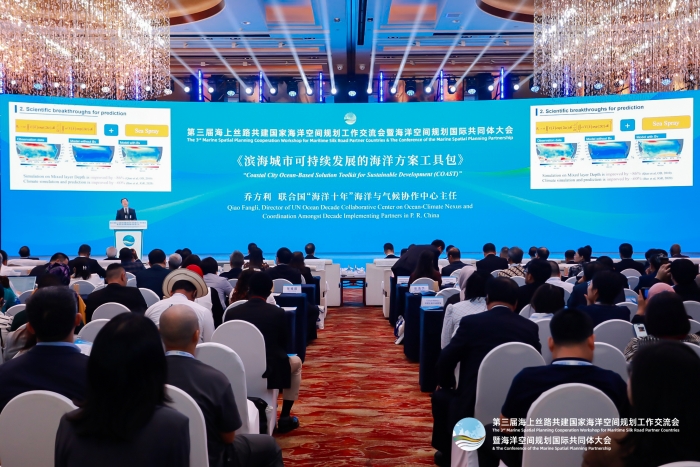
Our Director Dr. QIAO Fangli made a speech
To help Maritime Silk Road countries strengthen their ocean governance and climate resilience, Dr. Qiao, on behalf of DCC-OCC , together with China Oceanic Development Foundation, donated next-generation Jingwei buoys to Fiji, Yemen, Maldives, and Antigua and Barbuda. This practical initiative demonstrates China’s firm commitment to sharing scientific and technological advances with the world and building maritime community with a shared future, earning high praise from participating representatives.
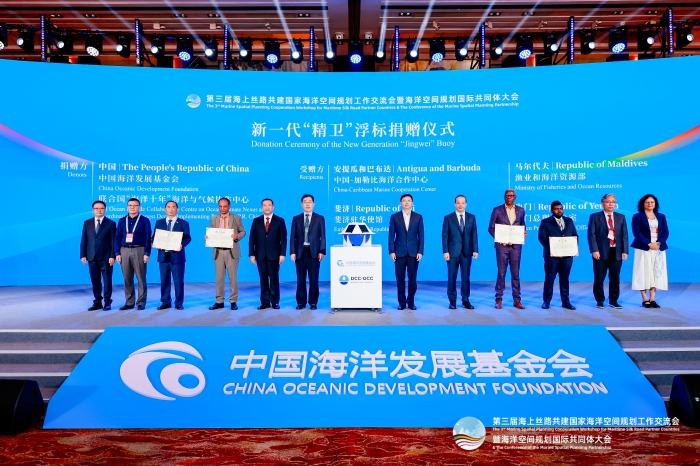
Donation Ceremony of the New Generation "Jingwei" Buoy
Amid the dual challenges of global ocean governance and climate change, advancing low-cost, technology-driven solutions has become a broad international consensus. Since its launching at the 3rd UN Ocean Conference in June, the COAST Toolkit has gained wide attention for its practicality and forward-looking design. It successfully translates cutting-edge marine science into accessible governance tools for decision-makers and the public, offering efficient and science-based Chinese solutions for coastal cities in disaster prevention, ecological protection, and resilience building.
The newly donated next-generation Jingwei buoys, with their “low-cost, high-precision, multi-parameter, compact, and intelligent” features, overcome traditional barriers of marine observation technologies and costs. They are expected to significantly enhance marine environmental monitoring and disaster warning capabilities in developing countries, especially small island states, inject fresh momentum into the global ocean observation network, and potentially lead the world into the fourth revolution of ocean observation.
The promotion and application of these two flagship products of the Cooperation Centre in Maritime Silk Road countries is not only a concrete action by China to participate in global ocean governance and fulfill its Ocean Decade commitments, but also a demonstration of how China’s independent marine technologies are empowering the Belt and Road Initiative. This effort further expands China’s deep cooperation with relevant countries in marine science research, technology transfer, and capacity building, making a strong contribution to South-South cooperation and to building a sustainable blue future for all.

