


From December 26 to 27, the 2025 Workshop on Promoting the Implementation of Ocean Decade was successfully convened in Guangzhou. Under the theme of “Strengthening the science–policy interface to empower the Ocean Decade,” the workshop provided a systematic exchange on the latest progress and representative achievements of China’s actions under Ocean Decade. It also organized thematic discussions on science-based decision-making support, cross-sectoral cooperation, and resource mobilization, helping to build consensus and strengthen momentum for China’s sustained and in-depth engagement in the Ocean Decade.
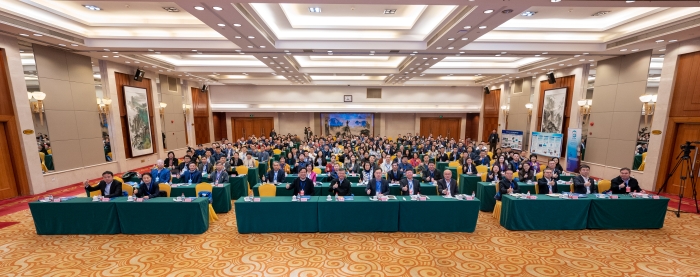
Group photo of all the participants
The workshop was jointly organized by DCC-OCC and the South China Sea Bureau of the Ministry of Natural Resources. It brought together domestic lead institutions of Decade actions, as well as government agencies, universities, enterprises, international organizations, and non-profit organizations supporting the Ocean Decade, with more than 230 experts and representatives from 105 institutions participating. LEI Bo, Director General of the South China Sea Bureau of the Ministry of Natural Resources; QIAO Fangli, Director of DCC-OCC; and QU Jiashu, Deputy Director General of the Guangdong Provincial Department of Natural Resources, attended the opening ceremony and delivered keynote remarks.
In his remarks, Director General LEI Bo noted that over its 60 years of development, the South China Sea Bureau has accumulated extensive experience in marine survey and monitoring, ecological conservation and restoration, disaster forecasting and mitigation, policy research, and ocean governance. These experiences can contribute to advancing the sustainable development objectives of the Ocean Decade. In particular, the Bureau’s practices in island protection and management can offer valuable references for island governance in small island developing states.
Looking ahead, the South China Sea Bureau will work collaboratively with all relevant stakeholders to jointly promote scientific understanding of the ocean, objective assessment of marine conditions, and the harmonious use of marine resources, thereby contributing South China Sea insights to global ocean governance.
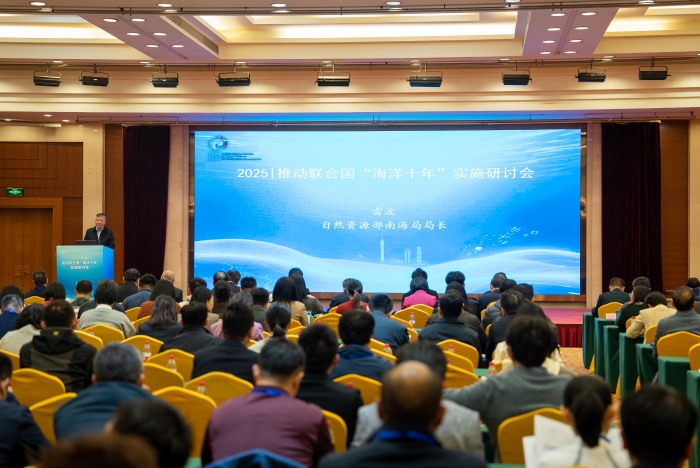
Openning Remarks from LEI Bo,Director General of the South China Sea Bureau of the Ministry of Natural Resources
Qiao Fangli, Director of DCC-OCC noted that since the planning and implementation of the Ocean Decade, China has been deeply engaged and has sustained strong momentum. To date, China has taken the lead in ten national large-scale scientific programs, ranking second globally. The Global Estuaries Monitoring (GEM) Programme led by Chinese scientists, as well as the High-resolution sea ice forecast in ARCtic routes (HiARC) project under the Ocean to Climate Seamless ForecastingSystem (OSF), were selected as exemplar initiatives addressing ocean challenges in the Ocean Decade Progress Report (2024–2025), marking China’s growing contributions in marine science and technology to global ocean governance.
As the Ocean Decade enters its critical second half, there is an urgent need to leverage this workshop to pool collective wisdom and build consensus in order to systematically advance the translation of scientific and technological innovation into ocean governance outcomes. This will help continuously enhance China’s level of engagement and visibility in the Ocean Decade and in global ocean governance, and further strengthen the contribution and leadership of Chinese solutions to global ocean governance.
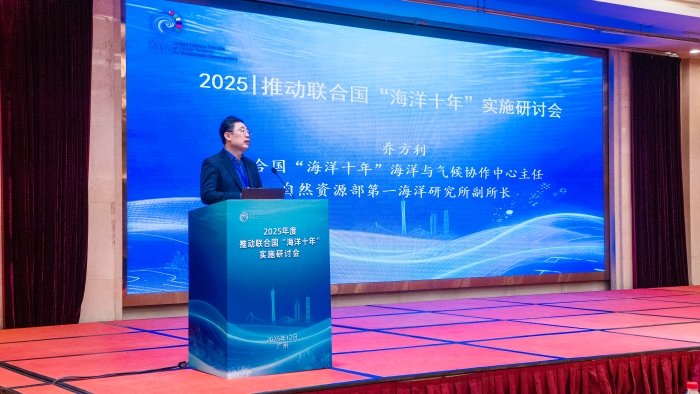
Remarks from QIAO Fangli, Director of DCC-OCC
Deputy Director-General Qu Jiashu stated that as a major coastal province, Guangdong has always placed high importance on the protection and sustainable development of the marine ecological environment. The province has been earnestly implementing the systematic governance philosophy of "from the mountains to the sea," with the expectation of making positive contributions to the realization of the goals of the Ocean Decade.
The keynote report session was presided over by WANG Hongbin, Deputy Director of the South China Sea Bureau of the Ministry of Natural Resources. Keynote reports were delivered respectively by Professor LEUNG Mei Yee, Chief Scientist of The Global Estuaries Monitoring (GEM) Programme and professor at City University of Hong Kong; Wu Lingling, Chief Engineer of the South China Sea Bureau of the Ministry of Natural Resources; and Professor Yu Weidong, Scientific Executive Director of DCC-OCCand Associate Dean of the School of Atmospheric Sciences at Sun Yat-sen University.
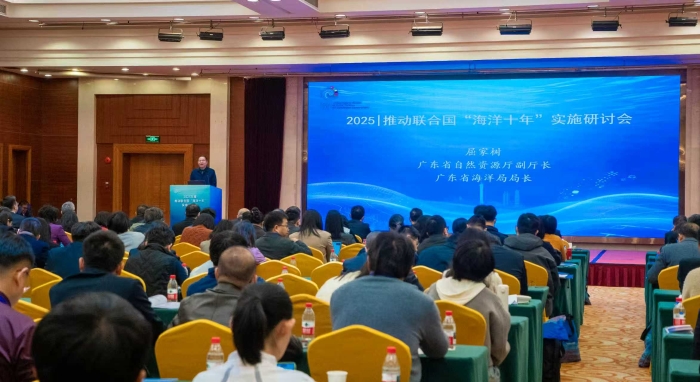
Openning remarks from QU Jiashu, Deputy Director-General of the Guangdong Provincial Department of Natural Resources
The keynote report session was presided over by WANG Hongbin, Deputy Director of the South China Sea Bureau of the Ministry of Natural Resources. Keynote reports were delivered respectively by Professor LEUNG Mei Yee, Chief Scientist of The Global Estuaries Monitoring (GEM) Programme and professor at City University of Hong Kong; Wu Lingling, Chief Engineer of the South China Sea Bureau of the Ministry of Natural Resources; and Professor Yu Weidong, Scientific Executive Director of DCC-OCCand Associate Dean of the School of Atmospheric Sciences at Sun Yat-sen University.
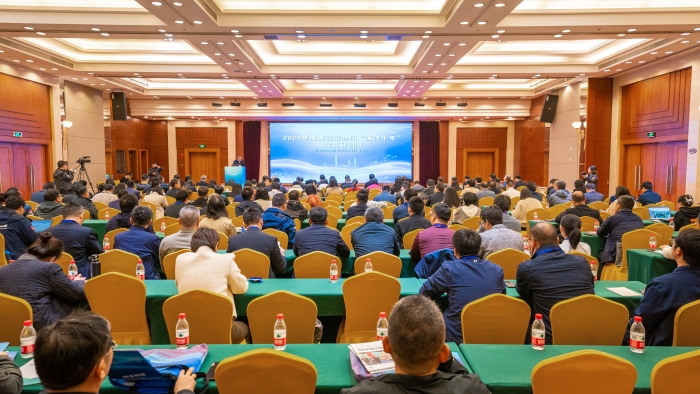
WANG Hongbin, Deputy Director of the South China Sea Bureau of the Ministry of Natural Resources moderated the keynot report session
Professor Leung pointed out that estuaries serve as critical junctions where land-based pollutants enter the ocean, and long-term standardized monitoring of global estuaries—particularly those near urban areas—should be promoted under the framework of the Ocean Decade. The GEM Programme aims to provide scientific support for policy formulation, facilitate the translation of research outcomes into governance practices, and contribute to ocean health and sustainable development through unified methodologies, data sharing, and capacity building.
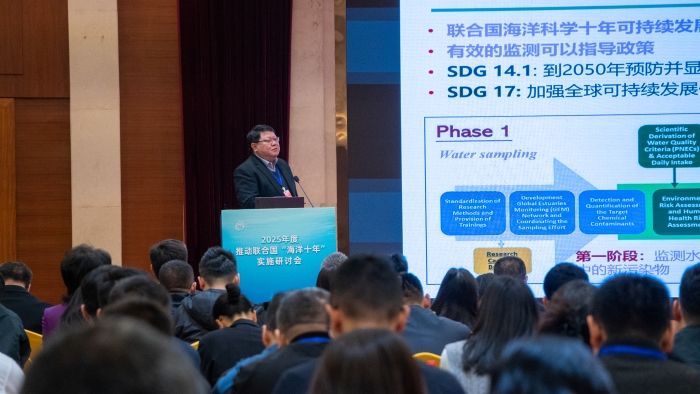
Professor Leung delivered a keynot speech
Chief Engineer Wu Lingling highlighted a major innovative achievement and practical experience of the South China Sea Bureau of the Ministry of Natural Resources in the field of ocean governance—the Island Governance Toolkit. This toolkit is designed to systematically integrate global best practices in ocean governance. By establishing a smart island governance operating system, it constructs a comprehensive, systematic, and replicable methodology for ocean governance, offering a Chinese solution for global island governance and strongly promoting the building of a maritime community with a shared future.
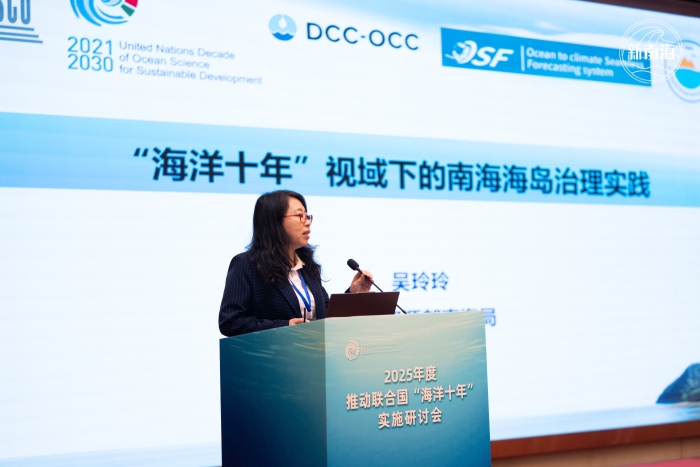
WU Lingling, cheif engineer of South China Sea Bureau delivered a keynot speech
Professor Yu Weidong introduced the key achievements of the DCC-OCC in advancing the implementation of the Ocean Decade. Notably, the Progress of Ocean Decade Actions in China(2021-2025), jointly compiled by the DCC-OCC and the leading Decade actions, has been highly commended by the UNESCO-IOC. The report has been published on the official website of the Ocean Decade, effectively showcasing China's contributions. Moving forward, we will continue to focus on building cooperative platforms, sharing public goods with the global community, promoting regional collaboration, enhancing ocean literacy, and strengthening support for the National Decade Committee.
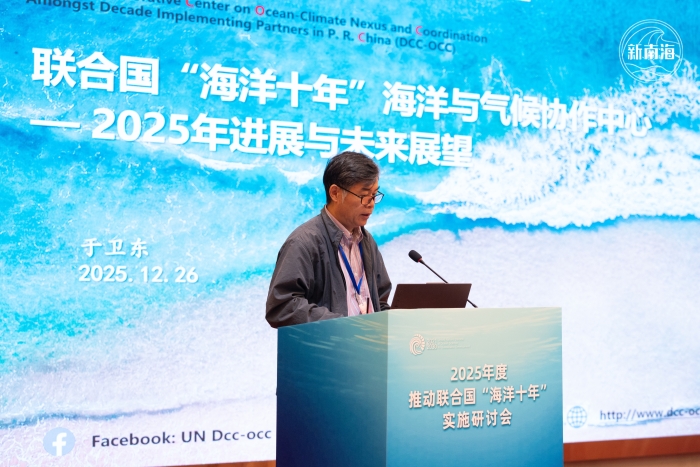
YU Weidong, scienfic director of DCC-OCC delivered a keynote speech
During the workshop, the Decade programs, as well as newly approved contributions and projects for the year 2025, presented their key progress, current challenges, and future implementation plans. In the results-sharing session, representatives from the South China Sea Bureau of the Ministry of Natural Resources and the Oceanic Administration of Guangxi Zhuang Autonomous Region shared practical experiences and collaborative explorations in areas such as marine forecasting, coral bleaching in the South China Sea, and the application of unmanned surface vehicle (USV) technology in marine environments.
In the thematic presentations and discussions, participants focused on topics including "From Nice to São Paulo: Science Informing Decision-Making," "From Science to the Public: Cross-Sector Collaboration," and "From Public Welfare to Science: Open Source for Efficiency Enhancement." Drawing on the progress of international conferences and practical case studies, they engaged in in-depth discussions on strengthening the integration of marine science and policy, enhancing public engagement, and fostering synergy between public welfare initiatives and scientific research. Several constructive recommendations emerged from these discussions.
All participants all agreed that the Ocean Decade represents the first global ocean science initiative in which Chinese scientists have participated deeply and comprehensively throughout its entire process. China should leverage its existing strengths and, in the crucial latter half of the initiative, continue to strive diligently. Efforts should focus on further integrating scientific and technological achievements with ocean governance, promoting broad societal participation, and firmly seizing the significant international opportunities presented by the Ocean Decade for the development of China's marine sector. This will inject strong momentum into accelerating the building of China as a maritime power.
DCC-OCC has successfully organized four consecutive annual workshops to advance the implementation of the Ocean Decade. These events have witnessed the robust growth of China’s engagement in the Ocean Decade, the continuous expansion of collaborative networks, and the emergence of numerous notable achievements. The center has evolved into a core platform for domestic exchange and cooperation under the Ocean Decade framework, providing strong support for the National Decade Committee.
This seminar served as both a platform for pooling wisdom and building consensus, as well as a mobilization toward action and shared future planning. Moving forward, the DCC-OCC will continue to leverage its strengths in international cooperation, deepen its participation in the Ocean Decade, and contribute more outstanding Chinese solutions to the sustainable development of the global ocean.

