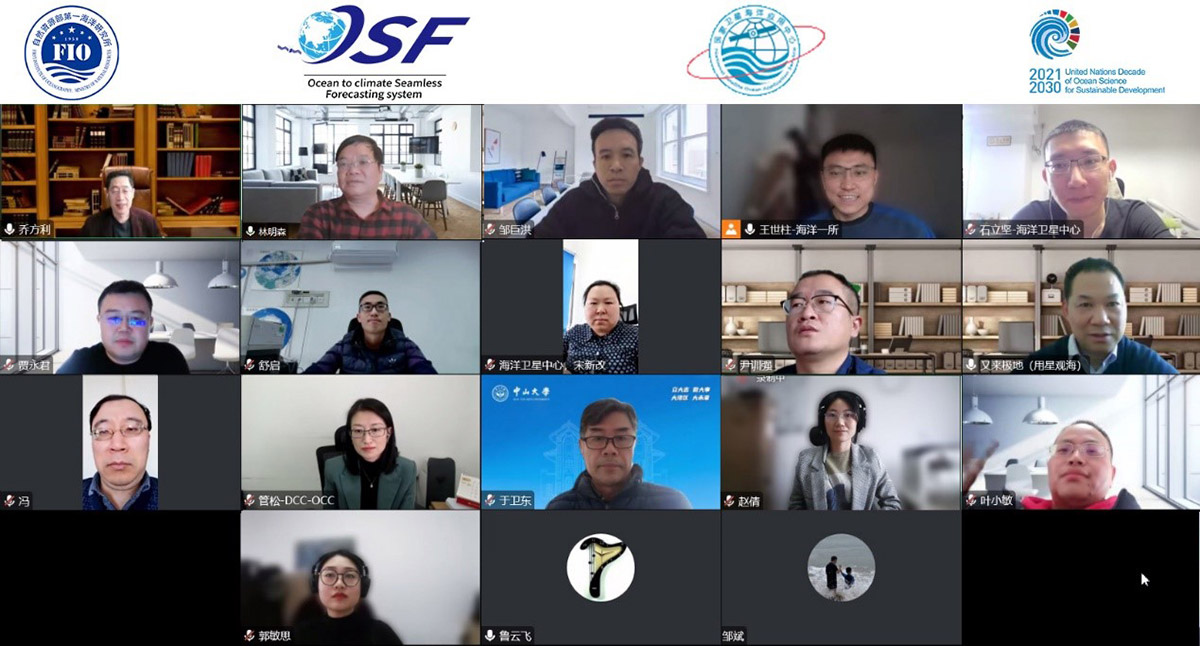


On 17 January, 2023, the OSF Office hosted a workshop on OSF's ocean satellite project, aiming to facilitate the implementation of this project and promote the application of high-precision satellite products in the UN Ocean Decade. With the participation of Prof. Mingsen Lin, Director of the National Satellite Ocean Application Service of China (NSOAS), Prof. Fangli Qiao, Principal Investigator (PI) of the OSF Programme, Prof Jianqiang Liu, PI of OSF’s ocean satellite project, and about 20 representatives from China's First Institute of Oceanography (FIO), NSOAS, UN Decade Collaborative Centre on Ocean-Climate Nexus and Coordination amongst Decade Implementing Partners in P.R. China (DCC-OCC), and the OSF Office, this workshop was organized online, and has provided an opportunity for discussion on the implementation of OSF's ocean satellite project. During this meeting, participants exchanged ideas on how to contribute to the Decade and what kind of satellite products and data sharing mechanism were urgently needed.
To kick off the workshop, Prof. Fangli Qiao and Prof. Mingsen Lin delivered speeches respectively, highly affirming the overall design and recent progress of the ocean satellite project while expressing requirements of serving international research and the Decade with high-quality Chinese ocean satellite products. Following the speeches, Dr. Shizhu Wang, Executive Director of the OSF Office, made a presentation on the background, major content and focal points of this project under OSF’s framework. After that, Dr. Lijian Shi from NSOAS introduced the ocean satellite products and existing applications of NSOAS.
During the discussion session, Prof. Jianqiang Liu, PI of the ocean satellite project, expressed that with more and more satellites operating under this project, the high-precision, multi-variables observation data they provided would significantly improve ocean satellites' observation competence. He believed that by combining the global ocean satellite public services developed under the framework of this project with the advanced ocean and climate models of the OSF Programme, this project would provide high-quality observation and prediction public service to the world, promote the sustainable development of the ocean and human society, and contribute to the advances in ocean and climate research. At the same time, participants conducted active discussions on the development and improvement of satellite products, the establishment of data sharing mechanism, and capacity building. It was agreed that a normalized communication mechanism would facilitate the implementation of the ocean satellite project and more importantly better support the UN Ocean Decade and the SDGs.
The ocean satellite project is the second of the seven projects coordinated by the OSF Programme.